The Future of Self-Employed Workers on the Labour Market
Self-employed vs employee?
CBS: nearly 1.3 million sole traders in the Netherlands
The future of self-employed persons on the labour market is about to change. In 2024 there were almost 1.3 million self-employed persons, a large number of whom the Cabinet considers to be false self-employed persons. These are self-employed persons who in fact qualify as employees. The Cabinet takes measures to fight false self-employment. These measures are relevant to all organizations that work with self-employed persons.
What is going on? Since 1 January 2025, the law is enforced on false self-employment
The Tax Administration has been enforcing the law on false self-employment since 1 January 2025. The enforcement suspension has therefore lapsed and no more model agreements are approved since this date. To soften the blow, it was decided that model agreements already approved will remain valid until the end of 2029. Importantly, the model agreements only offer certainty as long as the actual work is done in accordance with the description.
Enforcement is subject to a transition period of one year, i.e. until 1 January 2026. Unless there is malicious intent, the Tax Administration will not impose any fines within this period. However, the Tax Administration may still impose correction obligations and retrospective levies. It may normally do so with retroactive effect up to five years, but it has been announced that the Tax Administration will only do this with retroactive effect until 1 January 2025 (the date from the start of enforcement). This is a ‘transitional model’: only in 2030 will the Tax Administration be able to impose retrospective levies up to five years back.
This makes it important for organisations working with self-employed persons to establish carefully when there is false self-employment, and possibly to take measures.
How is an employee distinguished from a self-employed person?
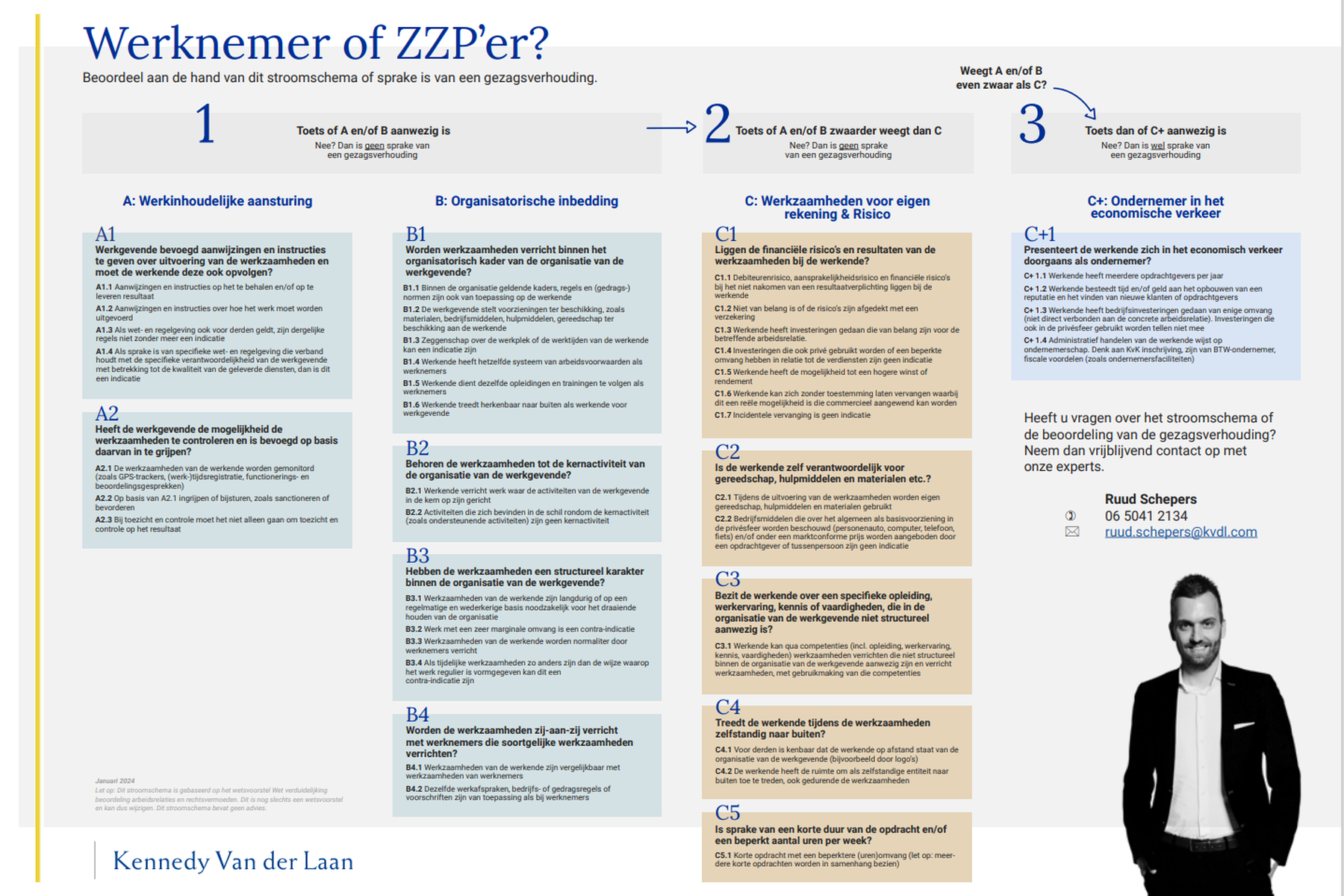
At the moment, the criteria from the Deliveroo judgment of the Dutch Supreme Court are used to assess whether a worker qualifies as an employee. To clarify this assessment, the cabinet recently presented a legislative proposal to the Lower House of Parliament. This proposal – the Assessment of Employment Relationships and Legal Presumption Clarification Act – has 1 July 2026 as its intended effective date. We will naturally keep you posted of the status of this legislative proposal.
Besides, on 8 April last our attorneys Eylard van Fenema and Ruud Schepers hosted the webinar 'The Big Self-Employment Talk’ in which recent developments were discussed (in Dutch). Would you like to receive a recording? You can request one via this link.
Prevent problems with false self-employment; please contact us
If a self-employed person qualifies as an employee, the (financial) consequences may be considerable. Therefore, it is important that you seek advice in time and take steps to fight false self-employment. After all, the lenient fining policy applies to fines only. As mentioned above, the Tax Administration may still impose correction obligations and retrospective levies. Besides, no enforcement suspension exists (or has ever existed) from an employment-law perspective. This means that false self-employed persons may also bring claims based on employment law with retroactive effect until the time before 1 January 2025. Trade unions and pension funds may also bring such claims.
Our specialists are ready to help you with this. If you have questions, please do not hesitate to contact one of our experts: Eylard van Fenema, Ester Damen, Ruud Schepers, Abderrahman Kichou or Marieke Opdam.


