In light of the developments in the self-employment field, we will keep you posted regularly through our Update on Self-Employment. In this Update on Self-Employment we will fill you in on developments, the impact on your organisation, and the action you should take.
On Monday, 7 July 2025, the Dutch cabinet sent the legislative proposal Assessment of Employment Relationships and Legal Presumption Clarification Act (Vbar) to the Lower House of Parliament. This bill intends to shed more light on when an employment agreement exists. The bill is part of a broader package of measures by which the cabinet intends to reduce false self-employment and to clarify the distinction between employees and self-employed persons.
In a previous article, we discussed the 2024 version of this bill. With reference to the advice of the Council of State and the recent answers of the Supreme Court in the Uber case, the cabinet has made adjustments to the bill. The answers in the Uber case have made it clear, among other things, that external entrepreneurship is a fully-fledged viewpoint in the assessment of whether or not an employment agreement exists.
In this article we will discuss the main elements of the bill.
Clarification of ‘to be employed by’ (authority)
In order for an employment agreement to exist, there has to be a relationship of authority between the employer and the employee. The bill provides for a clarification of this criterion. It was proposed to lay down the main elements for the assessment of a relationship of authority by law. Two main elements are key to this change:
- Work-related or organisational control of the employer (“E”)
- Working for one's own account and risk (“S”)
The review begins with the question whether there is work-related or organisational control of the employer (“E”). In the absence of such control, there is no relationship of authority. In the presence of such control, contraindications that indicate self-employment (“S”) are also taken into account. The review framework is clarified in the diagram below.
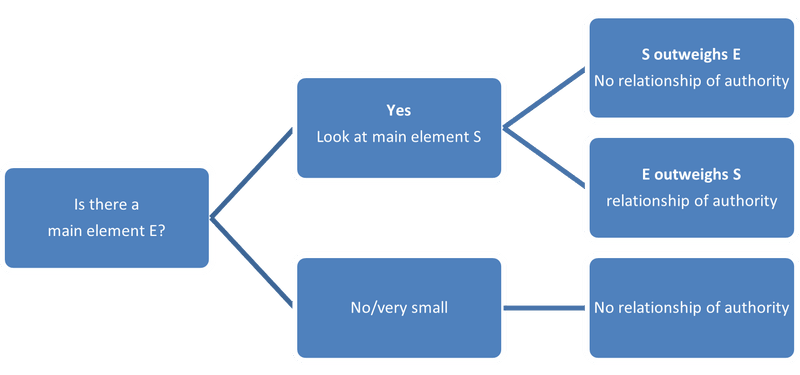
The indications that matter to the question whether these main elements exist will be included in a general administrative order still to be adopted. The indications that make up the main elements are already explained in the Explanatory Memorandum. The Deliveroo judgment forms an important legal basis for the indications that are mentioned in the bill.
The following indications suggest that a person is working under work-related or organisational control:
- The provider of work has the power to give orders and instructions on how the worker should perform the work, and the worker has to follow these.
- The provider of work is able to monitor the worker’s work, and has the power to intervene in this work on that basis.
- The work is performed within the organisational structure of the organisation of the provider of work.
- The work is of a structural nature within the organisation.
The work is performed side by side with employees who perform similar tasks.
The following indications, on the other hand, suggest that a person is working for his own account and risk:
- The worker bears the financial risks and enjoys the results of the work.
- The worker attends to performing the duties in a recognisable and independent manner.
- The worker has specific education, work experience, knowledge or skills that are not structurally present within the organisation of the provider of work.
- The assignment is short in duration and/or for a limited number of hours per week.
- Characteristics that indicate entrepreneurship of the worker (outside the employment relationship) for similar duties (external entrepreneurship)
To qualify the employment relationship, it is assessed on the basis of the indications on which main element the focus lies. This will determine whether there is a relationship of authority, and consequently whether there is an employment agreement.
Legal presumption
The bill also introduces a legal presumption based on hourly rate. Self-employed persons who earn less than €36 per hour can rely on this legal presumption. It is then up to the provider of work to prove that there is no employment agreement. The legal presumption is not a minimum rate for self-employed persons, but a legal tool to make it easier to claim labour law protection. The hourly rate is adjusted every year to the increase of the minimum wage.
Conclusion
The consequences of the clarification of the relationship of authority (‘to be employed by’) are expected to be limited. After all, the bill is intended to follow the way in which the courts currently assess whether an employment agreement exists. Introducing a legal presumption on the basis of hourly rate may have far-reaching consequences in certain sectors in which the remunerations of sole traders are relatively low. If the Lower House of Parliament agrees, the bill will go on to the Senate. If the Senate also agrees, the bill is scheduled to take effect on 1 July 2026.
It is important to emphasize that since 1 January 2025, the enforcement suspension has been lifted. This means that the Tax Administration is again actively fighting false self-employment and has the option of imposing retrospective levies. It is therefore essential that organisations take measures now to recognise and prevent false self-employment.
Do you have questions about the qualification of employment relations or what you can do to prevent false self-employment within your organisation? Please feel free to contact us.


