Since 30 June 2025, crypto activation service providers (‘CASPs’) must have a MiCAR authorisation to be allowed to provide their services. In order to obtain and keep this authorisation, they have to meet permanent rules, including rules that serve to protect their clients.
CASPs that provide their services to consumers will have to follow general consumer (protection) rules as well as the MiCAR. The pre-contractual disclosure obligations to which CASPs are subject are particularly important. In this blog we explain which consumer rules CASPs have to observe, focusing on the pre-contractual information disclosure obligations.
Pre-contractual information disclosure obligations in the MICAR
We start with a brief overview of the pre-contractual information disclosure obligations set out in the MiCAR. These rules are only a few. The MiCAR includes general information disclosure obligations for all CASPs. These apply with regard to all their clients:
- They have to provide their clients with information that is fair, clear and not misleading.
- They have to warn their clients of the risks associated with transactions in crypto-assets.
- They have to post their policies on pricing, costs and fees on their websites for clients to consult.
Besides these general requirements, specific crypto services are subject to additional pre-contractual information disclosure obligations. CASPs providing transfer services for crypto-assets, for example, have to include information in their customer agreements about the modalities of these services (i.e. the way in which they are provided) and the associated fees. In addition, the ESMA has clarified in its Guidelines that the costs of an individual crypto transfer must be disclosed to the client prior to the transfer. However, the MiCAR does not mention anywhere that CASPs receiving, forwarding or carrying out orders have to inform the client of the individual costs of each order in advance. The information disclosure obligations may therefore differ per kind of crypto service.
Online provision of crypto services and the Distance Financial Services Directive
Requirements from the Directives
The Distance Financial Services Directive (Directive (EU) 2023/2673) contains rules that apply to financial services agreements concluded with consumers at a distance. These are rules for the provision of pre-contractual information, the right of withdrawal and rules to protect consumers who conclude financial services contracts online. The Consumer Rights Directive (Directive 2011/83/EU) sets out similar, but still somewhat different obligations. As we will explain below, it is not clear whether crypto services fall under the Distance Financial Services Directive or under the Consumer Rights Directive.
We have listed the differences between these Directives below:
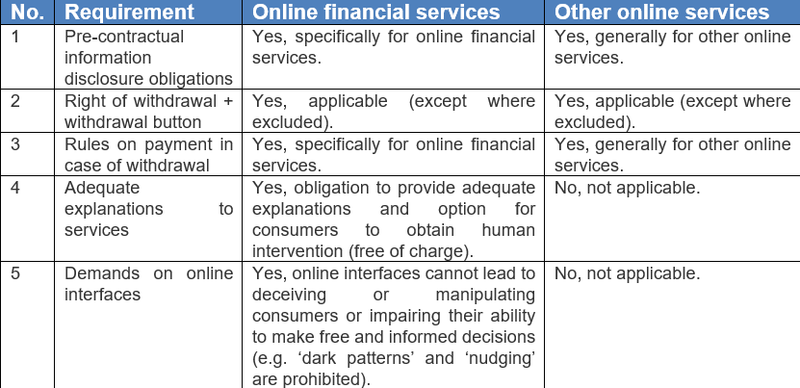
The recitals of the MiCAR refer to the Distance Financial Services Directive. According to recital 79 of the MiCAR, crypto services should be regarded as ‘financial services’ as defined in that Directive in cases where they meet the criteria of that Directive (if they are offered online, that is). The same recital says that if crypto services are offered at distance, they should be subject to the Distance Financial Services Directive, unless the MiCAR expressly provides otherwise. The European legislator thus qualifies crypto services as financial services under the Distance Financial Services Directive if they are offered online.
The Dutch implementation of the renewed Distance Financial Services Directive
However, in April of this year the Dutch legislator published the Implementation Act for the renewed Distance Financial Services Directive. The requirements will be elaborated in an Implementation Decree (to be published) in which the Financial Enterprises Conduct Supervision Decree (Besluit Gedragstoezicht financiële ondernemingen) will be amended.
Unfortunately, the Dutch legislator has not clarified in the Implementation Act whether crypto services are within or outside the scope. Quite casually, the Dutch legislator does not seem to qualify crypto services as ‘financial services’, so that they will not be covered by the Dutch statutory provisions for the implementation of the Distance Financial Services Directive. That would mean that crypto services are not subject to the Distance Financial Services Directive, but to the Consumer Rights Directive.
Unfortunately, the Dutch implementation of the renewed Distance Financial Services Directive seems to create a distinction between CASPs on the one hand (which have to meet the provisions of the Consumer Rights Directive that apply to other, online services) and parties providing financial services on the other hand (which fall under the specific requirements of the Distance Financial Services Directive).
In our opinion, the Dutch legislator is off the mark with its implementation of the Distance Financial Services Directive. We believe that crypto services to consumers should indeed fall under the Dutch implementation of the Distance Financial Services Directive, because the European legislator has stated clearly that CASPs offering online crypto services should apply the rules of the Distance Financial Services Directive.
Crypto services regarding e-money tokens
Incidentally, the Dutch implementation of the Distance Financial Services Directive does apply to CASPs that offer crypto services regarding e-money tokens to consumers. This is so because e-money tokens qualify as electronic money and therefore as a financial product. For many CASPs this is expected to be relevant. Crypto transfers often make use of e-money tokens, and consequently these crypto transfers qualify as payment services. As a result, these CASPs do fall under the scope of the Distance Financial Services Directive.
Cross-border services by CASPs
CASPs that provide cross-border services to consumers should look at the national implementation of the Distance Financial Services Directive in other countries within the EU. The Dutch implementation is not relevant here. In those other countries, the provisions from the Directive might be applicable to CASPs. Those countries might also have implemented stricter pre-contractual requirements or requirements on the use of online interfaces, as the Distance Financial Services Directive offers Member States room to do so.
Conclusion
All things considered, the following picture emerges from the above:
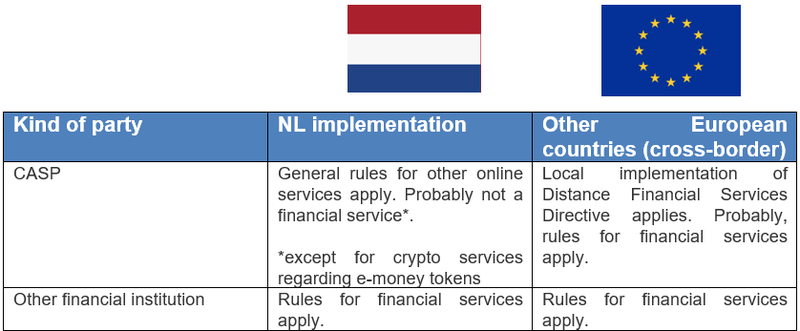
Despite the lack of clarity in Dutch legislation, we still advise CASPs to take into account the requirements set out in the Distance Financial Services Directive, because a breach of these requirements towards consumers may have unpleasant consequences.
Unfair Commercial Practices Act
Besides the requirements in the MiCAR and the Consumer Rights Directive or the Distance Financial Services Directive, CASPs also have to comply with the Unfair Commercial Practices Act when they provide consumers with crypto services.
Importantly, when providing pre-contractual information, CASPs have to provide consumers with the essential information on their crypto services and products. This is information that a consumer needs in any case in order to be able to make an informed decision. If the mandatory pre-contractual information is not provided or provided incorrectly to a consumer, this constitutes a misleading omission and therefore an unfair commercial practice, as a result of which the consumer may annul the agreement.


