Leon Mensink interviews the client with whom he has been working for thirteen years in many lawsuits on the division of operating rights for service-providing to drivers.
In 2012, Fastned rolled out a network of charging stations along the Dutch motorways. Back then, six parties took part in the draw for new licences for independent charging stations. How come that Fastned made it and the others did not?
Fastned focuses on one thing only: rapid charging stations. That is what we work on day and night. The other parties lacked this focus; they did a bit of charging on the side. They were either big organisations with a variety of activities, like the ANWB, or parties focused mainly on inner-city locations for slow charging, like Allego, or on the leasing of electric cars, like MisterGreen. This cannot be compared to our approach. We believed 100% in the rise of electric driving and the crucial role that rapid charging infrastructure would play in it. That infrastructure had to be realized in order to convince people to switch to an electric car. Charging had to be reliable and to become available in the best spots to reach as many drivers as possible. Locations, locations, locations: that was the main thing for us. Once this charging infrastructure would be there, electric drivers would enjoy the same freedom as other motorists: to go and stop wherever and whenever they want without ‘range anxiety’.
When you started Fastned, electric cars were still widely regarded as a kind of upgraded golf carts. Where did your faith in electric driving come from?
Michiel Langezaal and I knew each other from Epyon (later called ABB), which produces rapid chargers. We had seen the opportunities of electric cars and what was expected of their introduction to the general public. This convinced us of the growth potential of electric driving. Moreover, it is a consumer product; producers will want to market ever new and improved models. The only thing still missing was the possibility of rapid recharging on the road. The fear of getting stranded with a flat battery would deter people from driving electrically. Hence our belief in rapid charging locations as the key thing to offer. As devotees of electric driving, we were ready to break this chicken-and-egg situation and to build rapid charging stations even before there were enough electric cars to allow their profitable operation. Michiel and I founded Fastned with that objective in mind. We wanted to create charging stations that offer reliable charging services in the right places and compensate with their beautiful, optimist design for the drab world of petrol stations and parking lots along the highways.
Before a single rapid charging station had been built, the petrol stations already brought proceedings against the State of the Netherlands to stop your arrival. Did you never have doubts?
Never. We even saw it as a confirmation. Our idea was so good that the petrol stations sued it; they sued an idea. Even while the five of us were still crafting the first impressions and scale models, we were apparently such a threat to the petrol stations already. They would later imitate us by installing chargers at their stations too.
A downside of the interim injunction proceedings in 2013 was that the Dutch State wanted to reassure the petrol stations by promising that no shops would ever be allowed near the charging stations. Bridging the waiting time during charging is important, so we definitely intended to offer coffee and croissants as well. The first thing that Shell did when it installed its first chargers at a petrol station was offering free coffee to charging motorists.
It wasn’t until many lawsuits later that the State could not simply deny us anymore to offer electric drivers food and drinks. Luckily the first shops are now finally appearing at Fastned stations, but in many places the remaining operating term is already too short to make this investment still.
How did you experience the role of the government in the roll-out of your charging stations network?
It is fantastic that the Dutch government chose so early to permit rapid charging stations for electric cars as a new service in the service areas along the motorways. This had an inspiring effect on other countries too. For example, the Swiss soon visited us to ask about our experiences in the Netherlands and how they could best go about distributing these new rights. On the other hand, countries like Germany are only willing to start issuing these rights now, after the court has forced them to. Initially, the German authorities only wanted to extend the ‘Tank und Rast’ monopoly with charging services, instead of giving new parties a chance.
But even in the Netherlands we soon found out that, no matter how much the energy transition is advocated, the protecting of vested parties and vested interests is deeply ingrained in the government. This gave us very hard times as newcomers in a market that had barely emerged yet. Sometimes the three of us would be in a courtroom facing a 30-person team of lawyers and traffic experts of the Directorate-General for Water Management, the Central Government Real Estate Agency, and the petrol stations.
Fastned sells electricity to electric drivers in ever bigger volumes. Do you often encounter bottlenecks and limitations due to grid congestion?
Yes, of course that is a big challenge for us now. We equipped our stations with solar panel shelters from the start, but that is not enough to provide all our visitors with electricity. We are therefore trying different solutions that allow us, despite the limitations on the power grid, to offer ever more and faster charging services to electric drivers. Moreover, we can offer grid managers flexibility because of Fastned’s many locations. Batteries will also become available more widely and cheaply, so that grid congestion will become less of a problem for rapid charging stations.
Final question: how do you see the future?
This is only the beginning of the transition towards electric driving. In the Netherlands alone, millions more of electric cars are still to come. Fastned is now moving from a nationwide network in the Netherlands to a fully-fledged European network of rapid charging stations. Station by station, we contribute to the electric driving transition, which is necessary to push back greenhouse gases emissions and help prevent severe climate change.
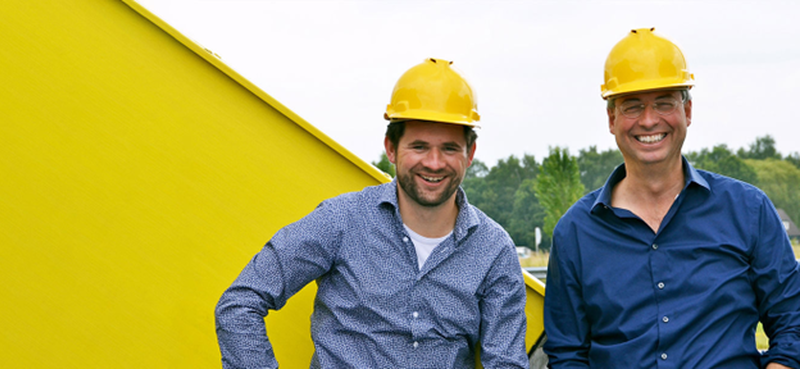
Michiel Langezaal and Bart Lubbers, founders of Fastned, at the construction site of one of the first stations. Photo from the Fastned website.
About Fastned
Fastned accelerates the transition to electric mobility. Since 2012, Fastned has been at the forefront of European charging infrastructure development, building and operating a rapidly growing network of iconic fast charging stations. The yellow, nature inspired stations create a welcoming environment for drivers during the 15 minutes it takes to charge up to 300 km of range. By offering Europe’s most reliable, convenient and joyful charging experience, we aim to inspire millions to drive on solar and wind energy so that together we can curb climate change. Fastned is listed on Euronext Amsterdam (AMS: FAST) and is a certified B Corp.


