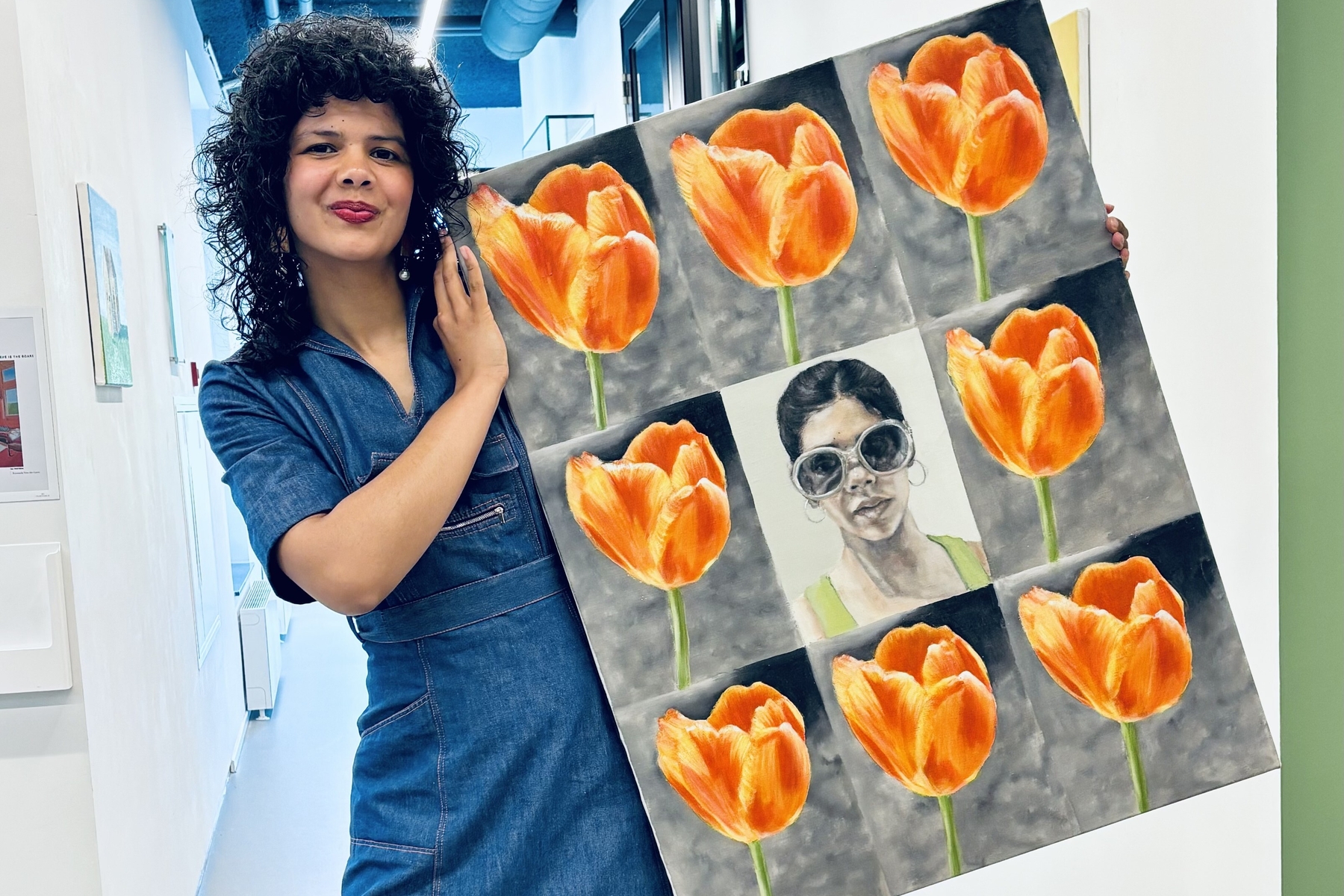
From the very first day that our firm was established, art has been an important binding element. That is why we have a dedicated wing that features a different artist every few months.
Since a week, our walls are filled with the work of Surinamese-Dutch artist Faria van Creij-Callender . At the temporary exhibition ‘She Is The Board’, fictitious female characters can be seen who are composed from elements of Faria’s own body, encounters and cultural references. A recurrent motif in her paintings is the chessboard, which symbolises navigation between colour, origins and culture.
In the run-up to the art drinks on 27 June, where our doors are open for everyone who wants to see and experience the exhibition, we interviewed Faria. We asked her about her background, and what it is like to exhibit in a place that is usually reserved for meetings, calls, and thought. What happens if art enters a working environment rather than a gallery?
What role does your background or personal history play in your work, and how does this translate on a canvas?
My Surinamese-Dutch origins are the core of my work. As a person with a mixed background, I am always ‘in between’ cultures, an experience I design time and again in each new composition. On the canvas I weave layers of colour and time; from skin colour and incidence of light to the past and present of painting, combined with symbols that serve as a visual ‘alphabet’ of my outlook on the world.
Each portrait is an assembly of images from my daily life and photographs from various archives. My work is a tribute to my family history, but also an invitation to talk about which cultures shape us and which stories we need to spread in that context.
Your work is described as layered, personal, and socially engaged. Can you tell us something about the themes that you examine in the exhibition 'She Is The Board'?
In the exhibition She Is The Board I offer room to everyday acts of black women and women of mixed origins within traditional painting techniques and compositions. I work with dreamy, sometimes nostalgic scenes in which these women are simply present, without any particular act or function ascribed to them. This way I shape current images of women of colour in whom I recognise myself. They are daydreaming and leaving their stamp behind in this world, as I do. Recurrent symbols like horses, tulips or a chessboard refer to the in-between existence; life between several cultures.
With techniques inspired by historical painters I put my Surinamese-Dutch perspective into the bigger story of painting. This way, I attach my personal perspective to an art-history origin and offer a place to myself simply to exist, and with that the place of the black woman and the woman of mixed origin.
What does it mean to you to show your art in a business environment, rather than in a traditional gallery?
It is refreshing to show my works outside a traditional gallery. In the office of Kennedy Van der Laan a different way of looking will arise than in a traditional gallery; a more gradual way, interrelated with daily routines. I hope that visual connections between the works will be noticed over time. My paintings and drawings are interconnected in their shapes and symbolism.
How do artistry and the legal profession relate to each other in your opinion?
As a painter I think is it important to make the position of the black woman and the woman of mixed origins visible to create everyday images in which I can recognise myself, especially because I have not been able to retrieve this in painting yet. In that sense I see a parallel with the legal profession: attorneys make visible where people are within their rights and defend those who are overlooked on a structural basis.
I don’t do this in court, but on a canvas. With paint and picture I give room to people who are too often absent from the art world or have been overlooked for centuries. This too is a form of representation and justice.
To conclude: You have already received a number of prestigious prices / acknowledgements. What else is on your wish-list as an artist? What do you dream of?
Gosh! Well, I dream of taking up a residence in the Rijksakademie, and of course (ha ha) a solo in the Tate Modern in London once.
You are invited to take a close look at Faria’s art at the art drinks on 27 June. Please register via the registration form on our website.